Visalia Ransacker crime series
I'll Be Gone in the DarkThe Visalia Ransacker crime series was a run of as many as 130 burglaries in Visalia between April 1974 and December 1975, distinguished by extensive household disruption and the taking of small, personal objects. Its significance extended beyond the burglaries themselves: after the East Area Rapist attacks began in Sacramento, similarities in the offenders’ methods led investigators to consider a connection. The comparison became a persistent but contested investigative avenue, not a confirmed identification.
Scope and Pattern
The burglaries continued for less than two years and repeatedly struck the same four residential neighborhoods. The offender sometimes entered several houses in a single night: four or five on some occasions, and as many as twelve on another. He favored photographs, wedding rings, and other personal items, often leaving behind possessions of greater monetary value. Hand lotion also appeared repeatedly among the details that investigators noticed.
The name Ransacker captured a central feature of the series: the destruction and disturbance inside the homes seemed more important than the value of what was taken. He tore up or concealed family photographs, sometimes breaking their frames or removing the pictures altogether. He poured orange juice onto clothing taken from closets and left rooms thoroughly disordered. The conduct repeatedly turned ordinary household spaces and family belongings into targets, so that the aftermath registered as more than a straightforward theft.
The stolen objects were often small or idiosyncratic. He took trinkets, personalized jewelry, piggy banks, and redeemable Blue Chip stamps, but could remove cash from its hiding place and leave it on a bed. He unplugged appliances and clock radios, and sometimes took only one earring from a pair. These choices, set against the valuables left behind and the damage to the home, made the series distinctive for the combination of selective taking and spiteful disruption.
Intrusion and Preparation
The burglaries also carried a sexual element, evident in the repeated disturbance and arrangement of women’s undergarments. In one instance, the clothing was piled in a baby’s crib; in another, a man’s underwear was laid in a line along a hallway from the bedroom toward the bathroom. The pattern suggested that the offender searched for household products that could serve as lubricant, with a particular preference for Vaseline Intensive Care hand lotion. These details document the intrusions without making them reducible to theft: the offender manipulated private belongings and left signs of having moved through intimate areas of the home.
He also took precautions that indicate attention to escape and the risk of a resident returning. He generally kept more than one route out of a house available. In some homes, he arranged items such as perfume bottles or spray cans on doorknobs as a makeshift alarm, so that a disturbance could alert him. Such preparations sit in sharp contrast with the disorder he left behind: amid the apparent chaos, he took steps to preserve his own ability to leave.
On September 11, 1975, the series took a more alarming turn. An intruder entered the bedroom of the sixteen-year-old daughter of Claude Snelling, a journalism professor at College of the Sequoias, and attempted to take her from the house. He threatened her with a knife and a gun as he led her toward the back door. The episode marked a change from the burglaries’ repeated invasion of homes to a direct threat against a person. The account establishes this escalation, but does not provide enough detail here to characterize what followed.
The Proposed Link to Sacramento
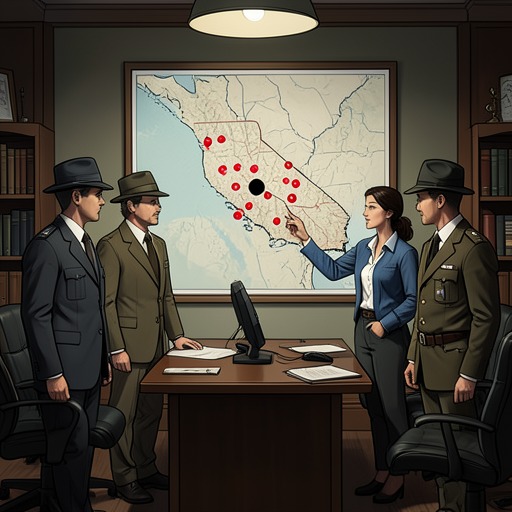
In late February 1977, Richard Shelby, at the Sacramento County Sheriff’s Department, received a call from Sergeant Vaughan of the Visalia Police Department. Vaughan thought information about the Ransacker might be useful to the East Area Rapist investigation. The timing offered an immediate reason to compare the cases: the Ransacker activity had stopped in December 1975, while the East Area Rapist series in Sacramento began about six months later.
Visalia investigators assembled at least a dozen similarities. Both offenders ransacked homes, selected trinkets and personalized jewelry while leaving more valuable property, and used a similar approach to sleeping victims. Both had used household objects as makeshift alarms, entered by prying around a doorjamb to bypass the striker plate, and jumped fences. Investigators also noted similarities in height, the removal of purses from residences and disposal of their contents outside, and the offenders’ movement through multiple houses in a neighborhood. Taken together, the parallels made comparison seem compelling enough to pursue.
Sacramento County Sheriff’s personnel, however, saw serious obstacles to the theory. They found that six of nine behavioral factors did not match, and pointed to differences in shoe impressions and shoe sizes. The East Area Rapist did not take Blue Chip stamps, while descriptions of the two offenders differed substantially. Accounts of the Ransacker described a notably heavy-set figure with short limbs and fingers and pale skin; the East Area Rapist was described as medium to slight in build, with one victim calling him puny, and appeared tanned in summer. The mismatch in physical descriptions made a single offender seem difficult to reconcile with the evidence then available.
Investigation and Unresolved Significance
The disagreement moved into public view in July 1978, when the Sacramento Union promoted the possible connection and criticized the Sacramento County Sheriff’s Department for dismissing it. The department responded the following day, condemning the newspaper’s reporting as irresponsible and accusing the Visalia Police Department of seeking publicity out of desperation. The dispute made the proposed link a public controversy as well as an investigative question; neither side’s position, as described here, resolved the offender’s identity.
The investigation did not end with the exchange in the press. Sacramento County Sheriff’s personnel asked local utility companies for names of employees who had transferred from the Visalia area between December 1975 and April 1976. They identified two people, and both were eliminated. Separately, after a composite sketch based on an encounter with the Ransacker was released to local media in mid-December 1976, the offender never struck Visalia again. The account supplies that sequence but does not establish that the sketch caused the series to stop.
The Ransacker case remains important in the book as a comparison whose strongest evidence points in opposing directions. The shared tactics and the six-month interval between the end of the burglaries and the beginning of the East Area Rapist attacks invited a common explanation; the physical and behavioral differences resisted it. The book’s wider account of the East Area Rapist also describes neighborhood surveillance, preliminary prowling, and the use of domestic routines to select targets, giving the comparison a broader context without proving that the same person committed both series. The investigation’s value lies partly in preserving that distinction: a persuasive cluster of similarities can generate a lead, while differences and unconfirmed identity prevent the lead from becoming a conclusion.